


ChatGPT Image Jun 16, 2026, 09_18_41 PM

From Unemployed to Uniformed

Picture of Rajkumar Babloo Singh

Rajkumar Babloo Singh

Director
Homeland Group

Unemployed to Uniformed : The Homeland Security Transformational Journey


    In Manipur, where unemployment continues to affect the hopes of many young people and their families, the journey from uncertainty to dignity often begins with one meaningful opportunity. For many, that opportunity comes through training, discipline and uniformed confidence.
The story of Homeland Security is not merely about deploying guards at hotels, hospitals, institutions or corporate sites. It is a story of transformation. It is about youth who once faced unemployment, hardship and lack of direction, but are now building lives of responsibility and dignity.
At its heart, Homeland Security carries a clear mission: Ensuring Safety, Empowering Lives. The organization protects spaces where people work, study, heal and live. Beyond that visible duty, it empowers the people who stand at the frontline of safety.
 
A Practical Response to Youth Unemployment
 
Manipur has no shortage of hardworking youth. Many are willing to work, learn and improve. What is often missing is a structured pathway that connects them to training, confidence and employment. Without such a pathway, young people may remain dependent on families or take up uncertain daily wage work with little long-term growth.
Homeland Security’s model offers a practical response. It gives unemployed youth a disciplined environment where they can prepare for professional life. Through routine, training and placement, it moves them from hesitation to confidence and uncertainty to income. This transformation is not only about getting a job. It is about rebuilding self-belief.
 
Training That Builds Responsibility
 
At Homeland Security, training is not limited to duty instructions. It is about shaping attitude, conduct and discipline. Trainees learn punctuality, teamwork, hierarchy, communication, grooming, physical fitness, alertness and responsibility.
These qualities matter because the security profession demands more than physical presence. A trained security professional is often the first point of contact at a school, hospital, hotel, resort, office, residential complex or corporate facility. They manage access control, visitor movement, crowd discipline, emergency response and protection of people and property.
A well-trained guard can prevent confusion, guide visitors, respond calmly during emergencies and maintain order without unnecessary force. For many unemployed youth, this training becomes a turning point. The uniform becomes more than clothing. It becomes a symbol of responsibility.
 
The Uniform as Dignity
 
A security guard protects lives, assets and institutional reputation. He stands when others pass by. He watches when others relax. He manages situations quietly, often without public recognition. For an unemployed youth, wearing a uniform brings dignity. It changes how he sees himself and how society sees him. It allows him to support his family, live with purpose and stand as a contributor.
 
A Moment at Taj Ganga Kutir, Raichak
 
During a visit to Taj Ganga Kutir Resort & Spa,Raichak where Homeland Security guards are deployed, one such moment unfolded. As I reached the lobby, one of the guards came running towards me with visible emotion. Before I could understand what was happening, he tried to touch my feet.
I immediately stopped him and asked, “Why are you doing this?”
His answer was simple, but deeply moving. He said, “Sir, my daughter has started going to school.”
That one sentence carried the weight of an entire family’s struggle. The guard had married at a young age and had a daughter. Due to unemployment and financial difficulty, he had not been able to send her to a private school. Like many young fathers facing hardship, he carried the pain of not being able to provide the education he wanted for his child.
After joining Homeland Security and receiving regular employment, his life began to change. His salary was not just income. It became his daughter’s education, dignity for his family and hope for his future.
That moment explained the mission better than any slogan could. A guard in uniform is not only protecting property. Behind that uniform may be a daughter going to school, a family eating with less worry, or a father standing with pride after years of uncertainty.
Real Stories of Transformation
 
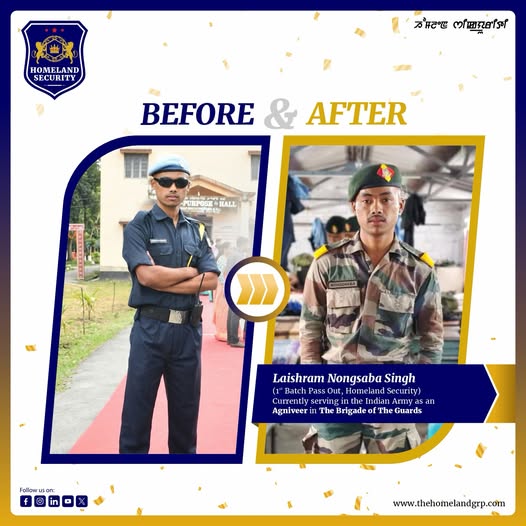
One example is Laishram Nongsaba Singh, a pass out of Homeland Security’s 1st Batch. From being a trainee, he went on to serve the nation in the Indian Army as an Agniveer in the Brigade of The Guards. His journey reflects discipline, preparation and opportunity. His success shows that a disciplined beginning can open the door to national service.
Another inspiring story is Elangbam Nandamani Chanu, a farmer’s daughter who lost her mother at a young age. She faced hardship early in life, but did not allow personal loss to stop her. As a member of Homeland Security’s 1st Batch, she received training and exposure that helped her prepare for professional life. Today, she works as a Hostess with Jones Lang LaSalle Incorporated in Pune. Her journey reminds young women that no dream is too far when courage meets opportunity.
Then there is Ningthoujam Ranjit Singh. Before joining Homeland Security, he worked as a brick factory labourer and struggled with Hindi and English communication. In May 2024, he joined Homeland Security’s 1st Batch and began his professional journey as a Security Guard. Through consistency, discipline and commitment, he rose step by step. Today, he serves as a Senior Supervisor at British Petroleum, Pune.
 
The Assam Rifles IGAR (South) Collaboration
 
A significant part of this journey is Homeland Security’s collaboration with Assam Rifles under the flagship of IGAR (South). This collaboration strengthens the mission of empowering unemployed youth of Manipur through discipline, training, confidence-building and meaningful employment.
The Assam Rifles has long played an important role in supporting peace, stability and community development in the Northeast. Through IGAR (South), its engagement with youth-focused initiatives reflects a commitment that goes beyond security. It supports constructive pathways that guide young people towards responsibility and a dignified future.
In partnership with this vision, Homeland Security works to create practical opportunities for youth searching for direction. The objective is not only to train individuals for security duties, but to shape them into responsible professionals who understand punctuality, teamwork, physical fitness, communication and public conduct.
 
Employment That Strengthens Families
 
Behind every trained employee is a family whose life also changes. In many households, one regular salary can support parents, educate children, help siblings, pay for medical needs and reduce daily financial stress.
Employment brings relief. It gives families the ability to plan. It allows parents to feel pride in their children. It gives younger siblings an example to follow. The story of the guard at Taj Ganga Kutir reflects this truth clearly. His job did not only benefit him. It helped his daughter enter school. It turned employment into education and a salary into family dignity.
 
Supporting Manipur’s State Economy
 
Homeland Security’s work also carries wider economic meaning for Manipur. With an average in-hand salary of around Rs 20,000 per month, many deployed personnel are able to send a major share of their income back home
.
If each employee sends around Rs 15,000 per month to support family members in Manipur, the collective impact becomes significant. With more than 650 employees, approximately Rs 97.5 lakh flows back to families every month. On an annual basis, this amounts to about Rs 11.7 crore being pumped into the state economy.
This money supports food, education, healthcare, transport, home repairs, farming needs, small businesses and daily household expenses. It circulates through local markets and strengthens the grassroots economy. A salary earned by one youth can become school fees for a child, medicine for a parent, income for a shopkeeper or support for a local transport worker.
 
Changing the Image of Security Professionals
 
The journey also calls for a change in public perception. Security personnel deserve respect. The guard at the gate is not invisible. The woman in uniform is not ordinary. The supervisor managing a site has not reached there by chance.
Each one carries a story of training, discipline and effort. Some have overcome unemployment. Some have supported families through hardship. Some have sent children to school. Some have risen from labor work into leadership roles.
 
Conclusion: Ensuring Safety, Empowering Lives
 
The Homeland Security transformation journey is a story of hope. It is about unemployed youth becoming disciplined professionals. It is about families finding support through regular income. It is about daughters going to school, parents gaining relief and young people standing with dignity.
From Laishram Nongsaba Singh’s journey to the Indian Army, to Elangbam Nandamani Chanu’s rise from hardship to professional identity, to Ningthoujam Ranjit Singh’s transformation from brick factory laborer to senior supervisor, these stories reflect the power of opportunity.
A uniform may appear simple from the outside. But for the youth who earns it, wears it and lives by it, it represents discipline, income, dignity and hope.
Homeland Security does not only ensure safety today. It empowers lives. And for many young people of Manipur, that empowerment begins the day they move from unemployed to uniformed

blog

Ensuring Safety, Empowering Lives

Picture of Rajkumar Babloo Singh

Rajkumar Babloo Singh

Director
Homeland Group

Ensuring Safety, Empowering Lives

  • Protecting People • Securing Assets • Building Stronger Communities

Ensuring Safety, Empowering Lives

India is passing through a period of rapid social, economic and institutional transformation. Cities are expanding, industries are growing, hospitals and educational institutions are becoming larger and public gatherings are becoming more frequent and complex. In this changing environment, safety has become one of the most important requirements for every organization.

Security today can no longer be treated as a simple arrangement of placing a person at the gate. It has become a professional responsibility that requires discipline, awareness, training, communication, emergency preparedness and accountability.

The role of a security guard has changed greatly. A guard is often the first person to receive visitors, observe unusual activity, control entry, guide people and respond when an emergency begins. He stands at the most practical point of safety. He may not be inside the boardroom where rules are framed but he stands at the gate where those rules are tested every day.

He is not merely wearing a uniform. He is carrying the responsibility of an institution, a client, the public and sometimes even human life.

This is why the transformation of private security into professional private security is no longer optional .

It is a necessity. The old belief that security only means physical presence has become outdated. A modern security guard must understand access control, visitor management, crowd control, emergency response, fire safety, first aid, communication discipline, patrolling, observation, reporting and the use of basic security technology. He must know how to behave with the public. He must know when to be polite and when to be firm.

He must understand how to prevent a situation before it becomes a rises. Most importantly, he must know how to act during the first few minutes of an emergency because those minutes often decide the safety of people and property.

A Mission beyond Manpower Supply

Homeland Security has taken up this mission with a clear vision. Its objective is not merely to provide manpower. Its objective is to build trained manpower. The mission is not only to give a uniform to a youth. The mission is to build discipline, confidence, responsibility and professionalism in the person wearing that uniform.

This is the true meaning of Ensuring Safety, Empowering Lives.

There are many large security companies in India with big contracts, wide manpower networks and strong corporate presence. However, the reality on the ground is that many organizations still fail to provide properly trained security personnel at the basic guard level.

In many places, the focus remains on deployment, replacement, billing and numbers. The actual development of the guard is often neglected. Many guards are sent to duty without adequate practical training, without emergency response knowledge, without professional grooming and without the confidence required to manage modern institutional environments.

This gap is one of the biggest challenges in the private security industry.

Homeland Security’s Mission to Transform Ground-Level Security and Empower the Youth of Manipur and Northeast India

A company may have a big name but if the guard at the gate is not trained, the service becomes weak. A management team may prepare excellent policies but if the guard does not understand how to implement them, those policies remain only on paper. a client may create strong SOPs, access rules, emergency plans and site instructions but the final implementation depends on the person standing at the ground level. That person is the guard.

Therefore, professional training at the guard level is not a small matter. It is the foundation of the entire security system. Consultants may prepare manuals. Officers may design emergency plans. Organizational may install CCTV cameras, biometric systems, access cards, alarm and visitor management software. However, in real field conditions, the person who must follow those rules, operate those systems, report suspicious activity and guide people during emergencies is the guard. If the guard is untrained, even the best system becomes weak. If the guard is trained, even a simple instruction becomes powerful

Why Ground-Level Training Matters.

Homeland Security believes that the transformation of the private security sector must begin from the ground level. Many institutions provide training for executives, officers, managers and specialized security professionals. Such training is important, but the most neglected section remains the basic security guard. The guard is the foundation of the security profession. He stands in rain, heat and cold. He faces visitors, workers, clients and the public every day. He patrols at night. He is often the first person to notice fire, theft, disorder, crowd pressure or suspicious movement.

Yet he is often the least trained and least recognized.

Homeland Security wants to change this reality. It wants to bring a ground-level revolution in the security profession. It wants to prove that professional security cannot be built only from the top. It must be built from the foundation.

If the guard is professional, the security service becomes professional. If the guard is disciplined, the institution becomes safer. If the guard is skilled, the client receives better protection.

If the guard is empowered, his family and society are also empowered.

The motto Ensuring Safety, Empowering Lives expresses the true spirit of this mission.

Ensuring safety means providing clients and institutions with trained, disciplined and reliable security personnel.

Empowering lives means giving youth the opportunity to earn, grow and live with dignity.

Homeland Security does both. It protects institutions and transforms young people. It provides safety to society and livelihood to families. It builds professional security service and at the same time builds human futures.

Empowering the Youth of Manipur and Northeast India

In Manipur and the wider Northeast region, this mission carries special importance. The region has many young people with physical ability, sincerity, discipline and willingness to work. However, many of them have not received access to structured professional training and employment opportunities.

Unemployment continues to be a serious concern for many families. The situation is more painful for economically weaker sections and Internally Displaced Persons affected by violence.

For these families, employment is not only about salary. It is about survival, dignity, hope and rebuilding life.

Homeland Security has taken responsibility for reaching such youths and giving them a professional path. Many of the young people who join the training come from uncertain back grounds. Some are unemployed. Some are from economically weaker families. Some have been affected directly or indirectly by violence in Manipur. Some have lost confidence because of lack of opportunity. Homeland Security brings them into a disciplined training environment where they are guided, corrected and prepared for employment.

This transformation begins with discipline. A youth who enters training without direction slowly learns the value of time, routine, uniform, command, teamwork and personal responsibility. He learns how to stand properly, speak properly, move properly and respond properly. He learns that professionalism is not only knowledge but behaviour. He learns that uniform is not decoration. It is responsibility. He learns that security duty is not about passing time. It is about alertness, trust and service.

Residential training and practical Skill development.

Homeland Security is residential training approach plays a powerful role in this transformation. A Classroom alone cannot create discipline. Discipline is created through daily routine and physical training, drill inspection, correction, teamwork punctuality and continuous practice. ( More To ADD)

A Career Path for the Future

For the youth of Manipur and Northeast India, professional security training creates a strong employment pathway. Many young people need an opportunity that gives them not only salary but identity. Security training can provide that path when it is done professionally. A youth can begin as a guard and, with experience, discipline and continuous learning, grow into a supervisor, control room operator, trainer, site-in-charge or security officer. The journey begins at the ground level but it does not have to end there.

Homeland Security’s mission is also connected to nation building. Every trained youth who enters employment becomes part of the productive workforce of the country. Every family that gains income becomes more stable. Every institution that receives trained security becomes safer. Every community that sees its youth employed gains confidence. Skill development, employment and security together contribute to national progress.

There is also a need to change public perception. Security guards should not be seen as low-level manpower. They should be seen as trained service professionals. Their work demands patience, discipline and alertness. They sacrifice comfort to protect others. They work during odd hours, festivals, nights and difficult weather. They stand for long hours so that others can work safely. When they are trained and treated with dignity, they perform better and society benefits.

Homeland Security Summit 2025: A Landmark Achievement

The successful conclusion of the Homeland Security Summit 2025 in Imphal marked a major achievement for Homeland Security and the wider security ecosystem of Northeast India. Organised by Homeland Security, a unit of Homeland Group, the summit brought together leaders from government, defence, academia and the private security industry under the theme “Integrated Security for a Changing World.”

The event was not merely a conference. It was a strong step toward building a more coordinated, professional and future-ready security environment in Manipur. One of the biggest achievements of the summit was its ability to place Manipur’s strategic importance at the centre of national security discussions. As India’s gateway to Southeast Asia, Manipur plays a crucial role in the Act East Policy and emerging trade corridors. The summit highlighted that this opportunity must be supported by stronger infrastructure, better surveillance systems, border management, cyber preparedness and public-private coordination.

The presence of senior leaders added great value to the event. Shri Arun Kumar Sinha, IAS, Principal Secretary, Government of Manipur, emphasised the need for integrated security built on domain integration, institutional integration and strategic integration. This gave the summit a clear policy direction and reinforced the importance of collaboration between government agencies, private security organisations and community stakeholders.

Another major achievement was the summit’s focus on professionalisation of the private security industry. CAPSI Chairman Kunwar Vikram Singh highlighted the growth of India’s private security sector and stressed the importance of proper training and regulation under PSARA. This strongly aligned with Homeland Security’s mission to develop disciplined, trained and employable security personnel capable of meeting modern industry standards.

The summit also created an important platform for knowledge-sharing through thematic panel discussions on security leadership, hospitality and service-sector security, digital-age threats, organisational safety and building a secure and resilient Manipur. Participation by leaders from organisations such as Walt Disney Company, Marriott International, IIRIS Knowledge and government administration reflected the credibility and relevance of the event.

A meaningful achievement was the launch of the Homeland Guide, a pocket-sized safety and information handbook for citizens and visitors to Manipur. By including emergency contacts and public safety tips, this initiative showed that Homeland Security’s vision goes beyond commercial security services and extends toward public safety, awareness and community support.

For Homeland Security, the summit stands as a defining milestone. It positioned the organisation not only as a manpower and guarding service provider but as a serious thought leader in security management, training, public safety and integrated collaboration. It strengthened Homeland Security’s identity as a leading security organisation from Northeast India and opened new avenues for collaboration, professional training and regulation.

Ensuring Safety and Empowering Lives

At its heart, the mission of Homeland Security is human. It is about a young person who gets a chance. It is about a family that receives support. It is about a client that receives trained manpower. It is about a society that becomes safer. It is about a profession that becomes respected. It is about turning struggle into discipline and discipline into livelihood.

Ensuring safety and empowering lives are not two separate goals. They are connected. When Homeland Security trains a youth, it empowers his life. When that trained youth protects an institution, he ensures safety. When safety improves, society becomes stronger. When youth are employed, families become stronger. This is the cycle of transformation Homeland Security is building.

The private security sector of the future must be professional, skilled and accountable. It must not depend on untrained manpower. It must not neglect the guard level. It must not treat security as a formality. It must recognise that real security begins with trained people. Homeland Security has understood this truth and has taken the mission forward with courage and commitment.

The journey from private security to professional private security is a journey from ordinary deployment to meaningful service. It is a journey from manpower to trained manpower. It is a journey from unemployment to employment. It is a journey from economic weakness to dignity. It is a journey from neglect to recognition. It is a journey from ground-level struggle to professional pride.

Homeland Security is not only participating in this journey. It is leading it. It is showing that a regional institution can create national impact when it works with vision, discipline and social commitment. It is proving that professional security service can become a tool for youth empowerment. It is showing that the most neglected level of the security profession can become the strongest foundation of change.

This is why Homeland Security stands as a game changer in the private security sector. It is bringing a much-needed revolution where it matters most: at the ground level. It is proving that when guards are trained properly, security becomes stronger. When youth are empowered properly, society becomes stronger. When safety and livelihood come together, the result is real transformation.

Ensuring Safety, Empowering Lives is not only a title. It is the working philosophy of Homeland Security. It is the promise behind every training batch. It is the purpose behind every free training initiative. It is the meaning behind every certificate and appointment letter. It is the hope behind every youth who enters training and leaves as a professional.