


In Manipur, where unemployment continues to affect the hopes of many young people and their families, the journey from uncertainty to dignity often begins with one meaningful opportunity. For many, that opportunity comes through training, discipline and uniformed confidence.
The story of Homeland Security is not merely about deploying guards at hotels, hospitals, institutions or corporate sites. It is a story of transformation. It is about youth who once faced unemployment, hardship and lack of direction, but are now building lives of responsibility and dignity.
At its heart, Homeland Security carries a clear mission: Ensuring Safety, Empowering Lives. The organization protects spaces where people work, study, heal and live. Beyond that visible duty, it empowers the people who stand at the frontline of safety.
A Practical Response to Youth Unemployment
Manipur has no shortage of hardworking youth. Many are willing to work, learn and improve. What is often missing is a structured pathway that connects them to training, confidence and employment. Without such a pathway, young people may remain dependent on families or take up uncertain daily wage work with little long-term growth.
Homeland Security’s model offers a practical response. It gives unemployed youth a disciplined environment where they can prepare for professional life. Through routine, training and placement, it moves them from hesitation to confidence and uncertainty to income. This transformation is not only about getting a job. It is about rebuilding self-belief.
Training That Builds Responsibility
At Homeland Security, training is not limited to duty instructions. It is about shaping attitude, conduct and discipline. Trainees learn punctuality, teamwork, hierarchy, communication, grooming, physical fitness, alertness and responsibility.
These qualities matter because the security profession demands more than physical presence. A trained security professional is often the first point of contact at a school, hospital, hotel, resort, office, residential complex or corporate facility. They manage access control, visitor movement, crowd discipline, emergency response and protection of people and property.
A well-trained guard can prevent confusion, guide visitors, respond calmly during emergencies and maintain order without unnecessary force. For many unemployed youth, this training becomes a turning point. The uniform becomes more than clothing. It becomes a symbol of responsibility.
The Uniform as Dignity
A security guard protects lives, assets and institutional reputation. He stands when others pass by. He watches when others relax. He manages situations quietly, often without public recognition. For an unemployed youth, wearing a uniform brings dignity. It changes how he sees himself and how society sees him. It allows him to support his family, live with purpose and stand as a contributor.
A Moment at Taj Ganga Kutir, Raichak
During a visit to Taj Ganga Kutir Resort & Spa,Raichak where Homeland Security guards are deployed, one such moment unfolded. As I reached the lobby, one of the guards came running towards me with visible emotion. Before I could understand what was happening, he tried to touch my feet.
I immediately stopped him and asked, “Why are you doing this?”
His answer was simple, but deeply moving. He said, “Sir, my daughter has started going to school.”
That one sentence carried the weight of an entire family’s struggle. The guard had married at a young age and had a daughter. Due to unemployment and financial difficulty, he had not been able to send her to a private school. Like many young fathers facing hardship, he carried the pain of not being able to provide the education he wanted for his child.
After joining Homeland Security and receiving regular employment, his life began to change. His salary was not just income. It became his daughter’s education, dignity for his family and hope for his future.
That moment explained the mission better than any slogan could. A guard in uniform is not only protecting property. Behind that uniform may be a daughter going to school, a family eating with less worry, or a father standing with pride after years of uncertainty.
Real Stories of Transformation
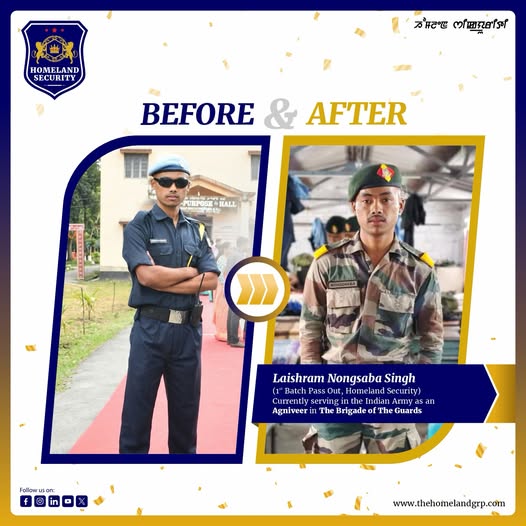
One example is Laishram Nongsaba Singh, a pass out of Homeland Security’s 1st Batch. From being a trainee, he went on to serve the nation in the Indian Army as an Agniveer in the Brigade of The Guards. His journey reflects discipline, preparation and opportunity. His success shows that a disciplined beginning can open the door to national service.
Another inspiring story is Elangbam Nandamani Chanu, a farmer’s daughter who lost her mother at a young age. She faced hardship early in life, but did not allow personal loss to stop her. As a member of Homeland Security’s 1st Batch, she received training and exposure that helped her prepare for professional life. Today, she works as a Hostess with Jones Lang LaSalle Incorporated in Pune. Her journey reminds young women that no dream is too far when courage meets opportunity.
Then there is Ningthoujam Ranjit Singh. Before joining Homeland Security, he worked as a brick factory labourer and struggled with Hindi and English communication. In May 2024, he joined Homeland Security’s 1st Batch and began his professional journey as a Security Guard. Through consistency, discipline and commitment, he rose step by step. Today, he serves as a Senior Supervisor at British Petroleum, Pune.
The Assam Rifles IGAR (South) Collaboration
A significant part of this journey is Homeland Security’s collaboration with Assam Rifles under the flagship of IGAR (South). This collaboration strengthens the mission of empowering unemployed youth of Manipur through discipline, training, confidence-building and meaningful employment.
The Assam Rifles has long played an important role in supporting peace, stability and community development in the Northeast. Through IGAR (South), its engagement with youth-focused initiatives reflects a commitment that goes beyond security. It supports constructive pathways that guide young people towards responsibility and a dignified future.
In partnership with this vision, Homeland Security works to create practical opportunities for youth searching for direction. The objective is not only to train individuals for security duties, but to shape them into responsible professionals who understand punctuality, teamwork, physical fitness, communication and public conduct.
Employment That Strengthens Families
Behind every trained employee is a family whose life also changes. In many households, one regular salary can support parents, educate children, help siblings, pay for medical needs and reduce daily financial stress.
Employment brings relief. It gives families the ability to plan. It allows parents to feel pride in their children. It gives younger siblings an example to follow. The story of the guard at Taj Ganga Kutir reflects this truth clearly. His job did not only benefit him. It helped his daughter enter school. It turned employment into education and a salary into family dignity.
Supporting Manipur’s State Economy
Homeland Security’s work also carries wider economic meaning for Manipur. With an average in-hand salary of around Rs 20,000 per month, many deployed personnel are able to send a major share of their income back home
.
If each employee sends around Rs 15,000 per month to support family members in Manipur, the collective impact becomes significant. With more than 650 employees, approximately Rs 97.5 lakh flows back to families every month. On an annual basis, this amounts to about Rs 11.7 crore being pumped into the state economy.
This money supports food, education, healthcare, transport, home repairs, farming needs, small businesses and daily household expenses. It circulates through local markets and strengthens the grassroots economy. A salary earned by one youth can become school fees for a child, medicine for a parent, income for a shopkeeper or support for a local transport worker.
Changing the Image of Security Professionals
The journey also calls for a change in public perception. Security personnel deserve respect. The guard at the gate is not invisible. The woman in uniform is not ordinary. The supervisor managing a site has not reached there by chance.
Each one carries a story of training, discipline and effort. Some have overcome unemployment. Some have supported families through hardship. Some have sent children to school. Some have risen from labor work into leadership roles.
Conclusion: Ensuring Safety, Empowering Lives
The Homeland Security transformation journey is a story of hope. It is about unemployed youth becoming disciplined professionals. It is about families finding support through regular income. It is about daughters going to school, parents gaining relief and young people standing with dignity.
From Laishram Nongsaba Singh’s journey to the Indian Army, to Elangbam Nandamani Chanu’s rise from hardship to professional identity, to Ningthoujam Ranjit Singh’s transformation from brick factory laborer to senior supervisor, these stories reflect the power of opportunity.
A uniform may appear simple from the outside. But for the youth who earns it, wears it and lives by it, it represents discipline, income, dignity and hope.
Homeland Security does not only ensure safety today. It empowers lives. And for many young people of Manipur, that empowerment begins the day they move from unemployed to uniformed